
Speech Therapist in Gujrat - Communicate More Clearly
Worried about late talking, unclear speech, stuttering or difficulty understanding language? See a speech therapist in Gujrat for child-focused speech and language support.
Make an Appointment
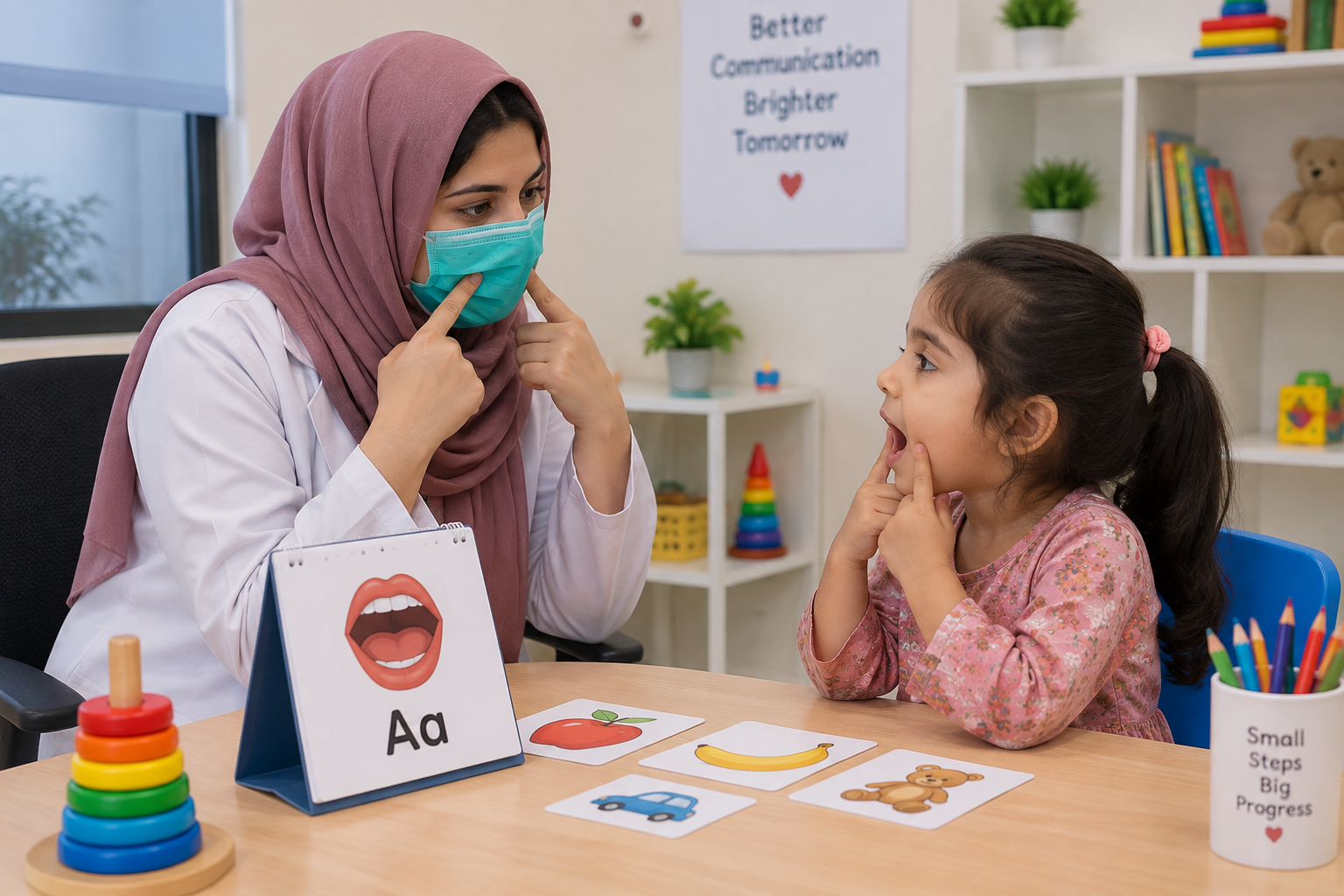
Why Choose Our Speech Therapy Services in Gujrat?
Assessment Before Therapy Goals
Your child’s speech and language abilities should be understood before deciding what needs to be addressed. Assessment may consider speech clarity, understanding, vocabulary, sentence use, fluency, and everyday communication depending on the concern.
Different Communication Needs Can Be Addressed
Children may need help with late talking, speech sound difficulties, understanding or expressing language, stuttering, or social communication.
Focus on Everyday Communication
Goals can relate to asking for help, answering questions, explaining needs, following instructions, participating in school, interacting during play, or communicating more successfully with family members.
Support Based on the Individual Child
Two children described as having speech delay may have very different strengths and difficulties, so their assessment findings and goals may also differ.
Related Services When Other Needs Are Present
If communication concerns occur alongside sensory or self-care difficulties that affect everyday activities, occupational therapy may also be relevant. If your child also has separate balance, strength, movement, or gross motor difficulties, physiotherapy may be relevant.
Inside Butt Autism & Rehab Center
Visit Our Clinic
 Address: Backside of Butt Brother Pharmacy, Katchery Chowk, Gujrat
 Opening Hours: Mon–Sat 9am–5pm
Butt Autism & Rehab Center is a therapy and rehab center in Gujrat providing different therapy services for children and adults according to their individual needs. If you are coming to our clinic, the clinic’s Katchery Chowk location is convenient for families traveling from different parts of Gujrat. It is located behind Butt Brother Pharmacy, close to Zahoor Elahi Stadium. Visitors coming from Fawara Chowk can reach the area through GTS Chowk, Service More, and Shadman, while families traveling from the University of Gujrat side can use the Loran route. The central location makes it easier for children, adults, parents, and caregivers to attend assessments, follow-up visits, and regular therapy sessions.
Call us for Free Consultation
Our Pricing
Physiotherapy → Rs.1500/session
Autism Therapy → Rs.1500/session
Speech Therapy → Rs.1500/session
Occupational Therapy → Rs.1500/session
Cupping Therapy → Rs.300/cup
How Do You Know If Your Child May Need Speech Therapy?
You do not need to know the professional name for your child’s communication difficulty before asking for advice. You may notice that your child uses very few words, rarely combines words, struggles to understand questions, leaves sounds out of words, speaks in a way that other people find difficult to understand, repeats sounds while speaking, or has trouble joining conversations. Some children become frustrated because they know what they want but cannot communicate it successfully. Parents looking for a child speech therapist can begin by describing what happens during normal situations at home, school, or play. Assessment can then help identify whether speech, language, fluency, or another communication area needs closer attention.
What Is Speech Therapy?
Speech therapy provides assessment and support for difficulties involving speech, language, fluency, and communication. Speech refers more specifically to the sounds and movements used to produce spoken words, while language involves understanding words and sentences and using them to express thoughts, needs, and ideas. Communication also includes using language appropriately with other people and in different situations. One child may understand everything but pronounce words unclearly, while another may speak clearly but struggle to understand instructions or organize sentences. A speech therapist in Gujrat can consider these different areas so support focuses on the communication difficulty that is actually affecting the child.
What Speech and Language Difficulties Can Speech Therapy Address?
Children may need speech and language support for different reasons. Some are late to begin speaking, some use words but are difficult to understand, and others have trouble understanding or expressing language. Fluency difficulties can interrupt the flow of speech, while social communication difficulties can affect conversation and interaction. These areas are related, but they are not the same problem. Understanding which part of communication is affected helps avoid treating every concern simply as “speech delay.”
Is Your Child Speaking Later Than Expected?
If your child is using fewer words than expected, rarely combines words, or relies heavily on gestures because spoken language is limited, you may be concerned about late talking. The number of words a child uses is only one part of communication. A speech and language assessment can also consider understanding, gestures, vocabulary development, word combinations, interaction, and the child’s ability to communicate needs. Some children mainly have difficulty expressing language, while others also struggle to understand what is said to them. Support should therefore reflect the child’s wider communication profile rather than focusing only on teaching more individual words.
Is Your Child's Speech Difficult for Other People to Understand?
Your child may know what they want to say but pronounce sounds or words in ways that make speech difficult for teachers, relatives, or other children to understand. They may leave sounds out, replace one sound with another, or use recurring sound patterns across many words. Speech sound difficulties can involve how individual sounds are produced or how sounds are organized within words. A speech therapist can listen to your child’s speech and consider which patterns are present, how understandable the child is, and whether those patterns are affecting communication. Therapy can then focus on the specific speech sound abilities that need support rather than treating the problem as general language delay.
Does Your Child Have Difficulty Understanding Language?
A child can have a language difficulty even when they speak regularly. You may notice that your child struggles to follow instructions, understand questions, learn new vocabulary, identify things when they are named, or understand longer sentences. This area is often called receptive language because it involves understanding information from other people. Difficulty understanding language can affect home routines, classroom learning, play, conversation, and the ability to respond appropriately. Assessment can consider how your child understands words, directions, questions, and increasingly complex language so support can focus on the areas interfering with everyday participation.
Does Your Child Struggle to Express Thoughts and Needs?
Some children understand much more than they can express. Your child may know what they want but have difficulty finding words, putting words together, answering questions, explaining what happened, or forming sentences that other people can follow. This is often described as expressive language difficulty. It can lead to frustration because the child has an idea or need but cannot communicate it clearly. Assessment can consider vocabulary, word combinations, sentence structure, storytelling, and functional communication depending on the child’s age. Therapy may then focus on helping the child express useful information more effectively in everyday situations.
Is Your Child Stuttering or Having Difficulty Speaking Fluently?
If your child repeats sounds or syllables, stretches sounds, becomes stuck before a word comes out, or appears tense or frustrated while speaking, you may be concerned about stuttering. Some disfluency can occur during normal speech development, but persistent or concerning patterns are worth discussing with a speech therapist. Fluency assessment can consider the types of interruptions, how often they occur, how the child reacts to them, and whether speaking is becoming difficult or stressful. Support should not consist only of telling the child to slow down or try again. The appropriate approach depends on the child’s age, fluency pattern, communication needs, and individual response.
Does Your Child Have Difficulty Using Language With Other People?
Communication involves more than producing words and sentences. Children also need to use language appropriately with different people and in different situations. Your child may struggle with taking turns in conversation, staying on a topic, knowing how to join an interaction, understanding what another person means, asking for clarification, or adjusting what they say depending on the situation. These difficulties are often described as social communication or pragmatic language difficulties. A speech therapist can consider how communication is used during real interactions so support relates to meaningful participation rather than focusing only on vocabulary or pronunciation.
How Can Speech Therapy Support an Autistic Child?
Autistic children can have very different communication profiles. Some use few spoken words, while others speak in full sentences but have difficulty understanding language, maintaining conversation, communicating needs, or using language socially. Speech therapy should therefore focus on the individual child’s communication abilities rather than using one speech program for every autistic child. Assessment can consider how the child understands and expresses information, communicates needs, interacts with other people, and uses language during everyday routines. When sensory responses, self-care, movement, or other developmental difficulties are also present, those separate needs may require occupational therapy, physiotherapy, autism-related support, or another appropriate professional service.
What Happens During a Speech and Language Assessment?
A speech and language assessment helps identify which communication abilities are developing well and which areas require closer attention. Parents may be asked when their child began using words, how the child communicates wants and needs, which languages are used at home, whether other people understand the child’s speech, and which situations cause difficulty. Depending on the concern, assessment may include speech sounds, vocabulary, sentence use, understanding of words and instructions, fluency, conversation, play-based communication, or social language. The purpose is to connect the child’s communication abilities with what happens in everyday situations rather than basing decisions on one isolated task.
How Is the Right Speech Therapy Approach Selected?
The approach should follow the communication difficulty identified during assessment. A child who struggles with particular speech sounds needs a different focus from a child who speaks clearly but cannot understand instructions. A child who understands language but uses very few words may have different goals from a child whose main concern is stuttering. Age, developmental level, languages used, communication abilities, and the situations where difficulty occurs can all influence planning. This is why speech therapy in Gujrat should not rely on one set of exercises for every child. Each activity should have a clear relationship with the communication skill being addressed.
How Are Speech Therapy Goals Decided?
Useful goals should connect with communication your child needs in everyday life. A younger child may need to request food, toys, help, or a break more successfully. Another child may need to understand classroom instructions, combine words into sentences, pronounce speech more clearly, answer questions, explain events, or take part in conversation. Assessment helps identify the skills contributing to the difficulty, while parents can describe which situations are most important or frustrating at home. Goals should be specific enough to review over time and should change as your child’s abilities develop. Therapy should have a practical communication purpose rather than consist of activities without a clear goal.
How Is Progress Reviewed During Speech Therapy?
Progress depends on the communication ability being addressed and should be compared with your child’s starting point. Improvement may mean using more words spontaneously, following instructions more consistently, producing a speech sound more accurately, forming longer sentences, communicating needs with less frustration, or using a new skill in more settings. A child may first demonstrate a skill during therapy before being able to use it naturally at home or school. If progress is limited, the therapist may need to reconsider the goal, difficulty level, therapy approach, home practice, or whether another factor should be investigated rather than continuing the same activities automatically.
Why Can Two Children With Speech Delay Need Different Therapy?
“Speech delay” can describe very different communication problems. One child may understand language well but use few words. Another may have difficulty both understanding and expressing language. A third may speak frequently but be difficult for other people to understand because of speech sound patterns. Communication may also be affected by hearing, developmental differences, autism, or other factors. For this reason, two children described by their parents as having speech delay may need different assessment priorities and different therapy goals. The child’s actual communication profile should guide support rather than assuming that one speech delay routine is suitable for everyone.
How Can Parents Support Speech and Language Development at Home?
Parents have an important role because most communication happens outside the therapy room. Meals, dressing, play, books, shopping, travel, and other daily routines create natural opportunities for children to listen, respond, learn words, follow directions, and communicate choices or needs. The most useful home activities depend on the communication goal being addressed, so parents should understand why a strategy has been suggested. Constantly testing or correcting a child can make interaction less natural. Home support is more useful when it fits into everyday routines, follows the child’s interests where appropriate, and provides regular opportunities to understand and communicate without unnecessary pressure.
When Should Hearing or Another Professional Assessment Be Considered?
Speech and language difficulties can have different contributing factors, so hearing and broader development may sometimes need consideration. A child who does not consistently respond to speech, has a relevant hearing history, or struggles to understand spoken language may need hearing assessment by an appropriate hearing professional. Concerns involving social interaction, repetitive behavior, sensory responses, movement, learning, or loss of previously acquired skills may also require broader evaluation. A speech therapist focuses on communication, but another healthcare or developmental professional should be involved when the child’s needs extend beyond speech and language. Additional assessment can help clarify the wider picture rather than replacing communication support automatically.
Does Speaking More Than One Language Cause Speech Delay?
Using two or more languages does not by itself cause a speech or language disorder. A multilingual child may know some words in one language and different words in another because language experience is spread across the people and situations where each language is used. Looking at only one language can therefore give an incomplete picture of the child’s communication abilities. Parents should tell the therapist which languages the child hears and uses, who speaks those languages with the child, and where they are used. When a genuine communication difficulty is suspected, the child’s overall language experience should be considered rather than assuming that multilingual exposure is the cause.
Call us for Free Consultation
Frequently Asked Questions About Speech Therapy in Gujrat
Should I Wait and See If My Late-Talking Child Catches Up?
Children develop language at different rates, and some late talkers make progress without long-term difficulties, but waiting alone cannot tell you which child will catch up. If you are concerned, assessment can look at understanding, gestures, vocabulary, word combinations, hearing considerations, and broader communication development. Asking for advice does not mean your child will automatically need long-term therapy. It can help determine whether monitoring, parent guidance, speech therapy, or another evaluation may be appropriate.
Does Speech Delay Always Mean Autism?
No. Speech or language delay can occur without autism. Some children mainly have language difficulties, while autism involves a broader developmental pattern that includes social communication and interaction differences together with restricted or repetitive behaviors or interests. If speech delay occurs alongside concerns involving interaction, routines, repetitive behavior, play, sensory responses, or other developmental areas, broader evaluation may also be worth discussing. Delayed speech by itself should not be used to diagnose autism.
Can My Child Need Speech Therapy Even If They Already Talk?
Yes. Speech therapy is not limited to children who use few or no words. A child may speak regularly but still have difficulty being understood, producing speech sounds, understanding instructions, finding words, forming sentences, answering questions, communicating socially, or speaking fluently. Assessment can separate these different areas so therapy focuses on the communication skill that is interfering with everyday interaction.
Can My Child Have a Language Difficulty Even If Their Pronunciation Is Clear?
Yes. Clear pronunciation does not necessarily mean that all areas of language are developing without difficulty. Your child may produce speech sounds clearly but still struggle to understand instructions, learn and use vocabulary, form sentences, explain events, answer questions, or take part in conversation. Speech and language assessment can look at these different communication areas separately so support is based on the ability causing difficulty rather than speech clarity alone.
Can My Child Understand Language but Still Need Speech Therapy?
Yes. Understanding language is only one part of communication. A child may understand questions and instructions well but still have difficulty producing clear speech, finding words, constructing sentences, speaking fluently, or communicating effectively with other people. Strength in one communication area does not rule out difficulty in another, which is why assessment looks at the child’s specific abilities rather than treating speech and language as one single skill.
Is Stuttering Always a Problem in Young Children?
Some repetition and hesitation can occur during normal speech and language development, but not every type of disfluency should automatically be ignored. Repeated sounds or syllables, prolonged sounds, blocks where speech seems stuck, visible tension, avoidance of speaking, or frustration may be reasons to discuss fluency with a speech therapist. The significance depends on the pattern, duration, age, family history, and effect on the child’s communication.
Should I Tell My Child to Slow Down When They Stutter?
Repeatedly telling a child to slow down, start again, or speak correctly can place extra attention on speaking. It is often more helpful to listen patiently, allow time for the child to finish, and focus on the message being communicated. The appropriate guidance can differ depending on the child’s fluency pattern, so parents should follow advice based on their child’s assessment rather than relying on one general instruction.
Can Speech Therapy Help an Autistic Child Who Uses Few Words?
Speech therapy may be relevant when an autistic child has difficulty understanding or expressing communication. Support does not always depend entirely on spoken words because some children may also use gestures, pictures, signs, or other communication methods depending on their needs. The goal should be useful communication that helps the child express needs, make choices, understand others, and participate more effectively in everyday situations.
Does My Child Need a Hearing Test Before Speech Therapy?
Not every child needs to arrive with a completed hearing test, but hearing is an important consideration when speech or language development is unclear. If there are concerns about responses to sound, understanding spoken language, speech development, or hearing history, an appropriate hearing evaluation may be recommended. Hearing assessment and speech-language assessment answer different questions and can both be useful depending on the child’s situation.
How Many Speech Therapy Sessions Will My Child Need?
There is no fixed number that suits every child. Therapy duration can depend on the type and severity of the communication difficulty, the child’s age and abilities, treatment goals, attendance, home practice, and how well new skills transfer into everyday communication. A child working on one speech sound may need a different course from a child with broader language difficulties. Progress should be reviewed periodically so ongoing therapy decisions reflect the child’s current needs.
Will My Child Receive Activities to Practise at Home?
Home activities may be suggested when they support the communication goal being addressed. Practice should be manageable and connected with therapy rather than becoming a long list of unrelated exercises. Depending on the goal, parents may be asked to model words, practise a speech sound, encourage certain sentence forms, create opportunities to follow instructions, or use communication strategies during everyday routines. The therapist should explain what the activity is intended to support.
At What Age Should a Child See a Speech Therapist?
There is no single age at which every child should begin speech therapy. The right time to ask for advice depends on what you are noticing, how communication is developing, and whether the difficulty is affecting everyday interaction. Parents do not need to wait until school age if they are concerned about understanding, spoken language, speech clarity, or fluency. Assessment can help determine whether monitoring, parent guidance, direct therapy, or another evaluation should be considered.
Should We Stop Using Our Home Language If Our Child Has Speech Delay?
Usually, families should not assume that using their familiar home language is causing the child’s communication difficulty. Children can learn more than one language, and their vocabulary may be distributed across the languages they hear and use. Tell the speech therapist which languages your child hears, who uses each language with them, and where those languages are spoken. Assessment should consider the child’s wider language experience rather than automatically asking the family to stop using a language that is important for everyday communication.
Why Can Local Speech Therapy Make Regular Appointments Easier?
Families may be balancing school schedules, work, household responsibilities, and other appointments while trying to understand why a child is struggling to communicate. A child who cannot easily explain needs may become frustrated at home, while difficulty understanding instructions or speaking clearly can affect school participation and interaction with other children. Having access to speech therapy in Gujrat can make regular appointments easier to manage when ongoing support is appropriate. Parents can begin by describing the communication difficulty they notice and how it affects their child’s everyday life rather than trying to identify the exact diagnosis before asking for advice.
Which Areas Can Families Visit From for Speech Therapy?
Children and families from across Gujrat can visit for speech therapy, including those living in Shadman Colony, New Shadman Colony, Model Town, Marghzar Colony, Lalazar Colony, Shalimar Town, Saleem Colony, Jalal Cheema Colony, Zeb Colony, Ahmad Town, Rashid Colony, Khalidabad, Kalupura, Bakhshupura, Hayat Pura, Qutababad, and other nearby neighborhoods. Families from areas around Bhimber Road, Rehman Shaheed Road, G.T. Road, Jalalpur Jattan Road, Sargodha Road, Railway Road, Shahdola Road, and surrounding parts of the city can also visit when a child needs assessment or support for speech, language, fluency, or communication difficulties. Families looking for a speech therapist in Gujrat can visit our Katchery Chowk location for assessment and support related to speech, language, fluency, or everyday communication difficulties.
Serving the City
Gujrat is home to around 574,000 people and has a strong local economy shaped by fan manufacturing, furniture, pottery, textiles, agriculture, trade, and education. The city includes busy commercial areas, long-established neighborhoods, schools, colleges, family businesses, and residential communities linked by major roads such as Bhimber Road, Rehman Shaheed Road, G.T. Road, Jalalpur Jattan Road, Sargodha Road, Railway Road, and Shahdola Road. For many families, choosing a speech therapy service within the city can make regular appointments easier to manage alongside school, work, and everyday family routines. Butt Autism & Rehab Center provides speech therapy in Gujrat for children who may have difficulties with speech development, language, pronunciation, fluency, understanding, or everyday communication. Families from different parts of Gujrat can access assessment and ongoing support closer to home.